

Abstract digital network diagram showing a combined shield and AI brain hub interconnected with data privacy, security, and risk icons.
AI Governance, financial services, Privacy & data protection, Regulatory Compliance

Pragmatic Convergence: Building a Lean Privacy and AI Governance Program for Broker-Dealers

Executive Summary

For years, financial services compliance playbooks were written by and for commercial banks. But broker-dealers (B-Ds) are fundamentally different: fast-moving, sales-driven, transactional, and notoriously lean. They view heavy, bureaucratic compliance structures as growth-throttling cost centers and reject massive capital expenditure on defensive software.

Today, B-Ds face a double-barreled threat: meeting strict new privacy mandates like the SEC’s amended Regulation S-P 30-day incident reporting rule, while simultaneously managing rapid, unvetted AI adoption across trading and sales desks.

The solution is not two separate compliance programs, nor is it simply overlaying AI checks onto legacy silos. The real answer is native operational convergence. By architecting data privacy and AI governance into a single operating engine led by a single accountable leader, B-Ds achieve complete regulatory coverage and advisor agility at a fraction of the cost.

What You Will Gain From This Guide:
  • The B-D Divergence Map: Why bank models fail, why governance requires a triangulation of Data, Tech, and Leadership, and why native transformation beats overlaying tech.
  • The Bidirectional Convergence Lens: How Privacy and AI Governance blend seamlessly from both directions, whether starting with data protection or model risk, and how to harness AI’s revenue-generating momentum.
  • A 5-Pillar Operational Blueprint: Includes a single accountable lead (“throat to choke”), embedded change management, a full 10-question unified PIA/AIA intake with human audits, concrete opt-out mechanics, global regulatory alignment, and accelerated 24 to 72-hour incident SLAs.
  • Advisor Buy-In & Dual Liability: How to protect both the firm and advisor under Reg BI while maintaining open channels with a strict 24 to 48-hour review SLA.
  • Tooling Leverage: How modern Privacy Management Platforms (PMPs) give lean teams the leverage to run a multi-domain program without inflating headcount.

1. Will Copying a Bank’s Privacy Playbook Work at Your Broker-Dealer?

To build a workable privacy program for a broker-dealer, you must first abandon the bank compliance blueprint:

Attribute Commercial Banks Broker-Dealers (B-Ds)
Business Model Slow-moving, relationship & balance-sheet heavy. Fast, transactional, market-driven, and sales-dependent.
Culture Risk-averse; structured “Three Lines of Defense.” Entrepreneurial, fast-paced, protective of client relationships.
Compliance Scale Large, multi-million dollar privacy & risk teams. Lean compliance teams where CCOs “wear five hats.”
Data Footprint Deep, long-term credit histories and deposits. High-velocity trading logs, portfolio data, suitability records, and chat logs.

The Triangulation of Governance: Data, Tech, and Leadership

Many compliance leaders observe that “AI risk is data risk.” While true, that view is incomplete. Data provides the raw fuel, Technology provides the algorithmic engine, but Leadership provides the strategic intent, risk boundary, and accountability. Without proactive leadership, data protection and tech innovation pull the organization in opposite directions.

Native Transformation vs. Passive Overlays

Most firms make the mistake of retaining legacy, siloed B-D workflows and simply overlaying AI governance checks on top of existing privacy rules. Layering duplicate controls onto existing silos creates bureaucratic friction and delays innovation. Forward-thinking B-Ds must natively transform their operational architecture. Data privacy and AI risk management should be built into core software procurement, data ingestion, and sales enablement workflows from day one, establishing a unified compliance posture by default.


2. Why Is Separating Data Privacy and AI Governance a Costly Mistake?

Building separate Privacy and AI Governance programs is financially and operationally non-viable for a lean B-D. Because both domains govern how data is captured, analyzed, shared, and stored, combining them into a single engine creates immediate operational synergy.

Convergence Architecture: Blending Data Privacy & AI Governance
Architecture Tier Risk & Governance Focus Key Operational Elements
1. Foundational Layer Unified Data & AI Catalog Single inventory mapping NPI data repositories alongside internal and vendor AI models.
2. Parallel Risk Domains Privacy Risk Domain
• Reg S-P Compliance
• Consent & Disclosures
• Data Minimization
AI Governance Domain
• Algorithmic Bias & Drift
• IP & Prompt Leakage
• Model Hallucinations
3. Integrated Control Engine Combined PIA / AIA Intake 10-question intake evaluating privacy rights, vendor training limits, suitability, human audits, and data purging.

The Bidirectional Blend: What If AI Governance Came First?

In practice, when organizations deploy artificial intelligence, AI controls are built in a completely separate silo. They are rarely retrofitted into privacy frameworks because business leaders fail to recognize the shared data-risk space between AI and privacy.

Furthermore, AI possesses a dual nature that traditional privacy lacks: AI has a major business dimension (revenue generation, advisor productivity, and sales alpha) alongside a risk and compliance perspective. Privacy, by contrast, is historically viewed by executives purely as a defensive, cost-center burden.

Understanding this commercial pull changes how governance should be architected. When a firm establishes AI Governance first, driven by business eagerness to deploy generative sales tools or predictive trading algorithms, the technical controls required to manage AI risk naturally satisfy core privacy obligations:

  • Model Lineage Demands Data Lineage: Ensuring an AI model produces compliant recommendations requires knowing what dataset trained it. Fulfilling this AI risk mandate automatically maps customer Non-Public Personal Information (NPI), solving the hardest part of privacy data discovery.
  • Context Windows Demand Data Minimization: Restricting the personal data fed into an LLM’s prompt window to prevent hallucination and prompt leaks directly enforces the foundational privacy principle of data minimization.
  • Algorithmic Transparency Demands Disclosures: Explaining automated rebalancing or predictive wealth algorithms to satisfy FINRA and SEC suitability rules creates the exact transparency mechanics needed for state Automated Decision-Making Technology (ADMT) privacy disclosures and international AI mandates.

By capturing the revenue-generating momentum of AI, smart B-Ds can piggyback privacy controls onto AI governance initiatives, turning business ambition into unified compliance leverage.


3. How Do You Build a Lean, Compliant Governance Blueprint on a Tight Budget?

To deliver complete regulatory coverage on a lean budget, B-D compliance leaders should deploy this 5-pillar operational framework:

5-Pillar B-D Governance Blueprint
1. Single Lead & Change Council Privacy & AI Lead (Single Point of Accountability) + Change Management Committee
2. Unified Data & Model Catalog Single live inventory for NPI data flows, vendor SaaS, and internal/external AI models
3. Native Consent & Opt-Out Engine Combined Reg S-P notices, state ADMT opt-outs, model training restrictions, and global AI framework alignment (e.g., EU AI Act, Colorado AI Act)
4. Full 10-Question PIA / AIA Intake Integrated intake for Data Minimization, Model Isolation, Suitability, Human Auditing, and Data Purging
5. Accelerated Incident & DSR Engine 24 to 72-hour AI triage SLA + 30-day SEC reporting + FINRA Rule 4511 recordkeeping overrides

Pillar 1: Name a Single Accountable Leader & Change Management Council

Programs fail when there is no single throat to choke. Appoint one executive, a designated Privacy & AI Governance Lead (often a dual-hatted CCO, Head of Operational Risk, or CPO/AIO), to own overall program success.

While this individual does not need to be a machine learning engineer or privacy litigator, they must possess a strong risk management background and a solid grounding in core data privacy and AI governance principles. Equipped with this foundational risk expertise, they leverage modern automated Privacy Management Platforms (PMPs) and chair a monthly Data & Tech Governance Committee composed of the CCO, CTO, Sales/Desk Lead, and Legal counsel.

To keep the framework evergreen, the Lead operates with a small, focused core team working in direct consultation with Legal to maintain a live inventory of applicable laws, rules, and regulations and map them directly into program controls. This core team is responsible for ongoing program maintenance, monitoring operational effectiveness, tracking regulatory shifts, and serving as a central advisory resource for the entire company.

Embedded Change Management: The Committee isn’t just an approval bottleneck; it is a change management engine. It establishes desk-level compliance champions, redesigned workflows that eliminate advisor friction, and active feedback loops to ensure policies fit real-world trading desk realities.

Pillar 2: Maintain a Unified Data & AI Model Catalog

Replace static spreadsheets with a single inventory mapping NPI data stores alongside internal and third-party AI models. Capture data sensitivity, hosting infrastructure, model types (rule-based algorithms vs. generative LLMs), and vendor training rights during initial software onboarding.

Historically, building and maintaining an accurate data inventory has been one of the most tedious and failure-prone exercises for financial services firms, often resulting in abandoned, outdated spreadsheets. Yet maintaining a comprehensive asset inventory is a mandatory regulatory requirement under comprehensive privacy laws, such as GDPR Article 30 (Records of Processing Activities), state privacy statutes like the California Consumer Privacy Act (CCPA/CPRA), and the SEC’s updated Regulation S-P safeguards requiring strict data mapping of Non-Public Personal Information (NPI). The good news is that modern tech tools, specifically Privacy Management Platforms (PMPs) equipped with automated data discovery and cataloging connectors, make building and sustaining a dynamic, live data and AI model inventory far more viable and operationally effortless than ever before.

Pillar 3: Operationalize Consent Architecture, Disclosures, & Global AI Requirements

Consent and preferences form the foundational cornerstone for managing data privacy, assessing incident blast radiuses, and servicing DSRs. If a firm cannot demonstrate valid consent or track preference revocations in real time, it cannot accurately enforce data deletion requests or determine whether an unapproved AI prompt input constitutes a regulatory breach.

This is precisely where the complementary nature of privacy and AI governance becomes clear. B-Ds operating across state or international boundaries must account for emerging AI regulatory frameworks, such as the EU AI Act’s high-risk system obligations, the Colorado AI Act’s algorithmic discrimination prevention rules, and SEC/FINRA risk guidance. Because both domains rely on transparent data handling and user control, operationalizing compliance by embedding consent management, global regulatory disclosures, and preference controls directly into B-D workflows creates a single, mutually reinforcing default posture:

  • Centralized Consent Tracking & DSR Linkage: Capture and log customer privacy preferences, opt-ins, and consent revocations across client portals and onboarding flows. Automatically link consent records to DSR workflows so when a client revokes processing permission or requests deletion, downstream AI pipelines and marketing databases are updated instantly.
  • Incident Scope & Blast Radius Evaluation: In the event of a data spill or AI prompt leak, having centralized, real-time consent metadata allows the Privacy & AI Lead to rapidly determine which clients gave permission for automated processing and which were improperly exposed, substantially reducing regulatory reporting uncertainty.
  • Automated Wealth Profiling (ADMT & AI Laws): Provide clear opt-out mechanisms for state laws governing Automated Decision-Making Technology (ADMT) and emerging AI statutes when algorithms generate automated portfolio rebalancing or risk profiling.
  • Vendor Model Training Opt-Outs: Automatically enforce contractual clauses prohibiting third-party software vendors from ingesting client NPI into their public LLM training datasets without explicit customer consent.
  • Reg S-P Third-Party Sharing: Harmonize annual SEC Reg S-P notices to allow clients to opt out of data sharing with fintech partners utilizing predictive analytics.

Pillar 4: Deploy the Complete 10-Question Integrated PIA / AIA Intake

Traditional compliance programs overwhelm vendors and internal software teams with generic, 40-page security questionnaires that stall software procurement and systems development. In a lean B-D, the tool is the operational delivery engine, while the 10-question intake is the distilled risk logic.

Rather than circulating static spreadsheets, modern Privacy Management Platforms (PMPs) host this 10-question assessment directly within the systems development lifecycle (SDLC) and procurement process. The tool uses conditional logic to automatically trigger the assessment whenever new software, internal system builds, or AI services are requested, scores risk in real time, and automatically populates the firm’s Unified Catalog, replacing bloated legacy paperwork with automated enforcement:

The 10-Question Integrated Privacy & AI Assessment (PIA/AIA)

  1. Data Classification: Does this system ingest, process, or store client Non-Public Personal Information (NPI) or confidential firm data?
  2. Data Minimization: Is the dataset restricted strictly to the minimum fields necessary to achieve the business purpose?
  3. Model Type & Global AI Risk Tier: Does the tool utilize generative AI, Large Language Models (LLMs), or predictive machine learning algorithms, and how is it categorized under frameworks like the EU AI Act or state AI laws?
  4. Vendor Model Isolation: Does the vendor contractually guarantee that firm data will never be used to train their public or multi-tenant models?
  5. Data Location & Boundary: Where is the data processed and hosted (e.g., dedicated private cloud vs. public multi-tenant infrastructure)?
  6. Algorithmic Suitability & Bias: Has the algorithm been tested for output drift, hallucination, or discriminatory bias in financial recommendations?
  7. Human-in-the-Loop Oversight & Auditing: Is a qualified human advisor required to review AI-generated outputs before client delivery, and is there a scheduled protocol for periodic human quality audits?
  8. Transient Data Deletion: Are temporary prompt inputs, caches, and intermediate processing files automatically purged immediately after session completion?
  9. Access Controls & Authentication: Are role-based access controls (RBAC) and multi-factor authentication enforced to limit data exposure?
  10. Audit Logging, Explainability & Human Verification: Does the tool maintain immutable logs of inputs, decision logic, and outputs to enable regular human compliance audits and regulatory examination?

Pillar 5: Streamline Incident Response & DSR Management

A Privacy and AI Governance program does not operate in a vacuum; it must seamlessly interface with the firm’s existing InfoSec Incident Management ecosystem. By connecting directly into InfoSec triage workflows and leveraging the Unified Inventory (Pillar 2) and Centralized Consent tracking (Pillar 3), B-Ds dramatically accelerate incident identification, blast radius determination, and inquiry handling:

  • Interface with InfoSec Incident Management: Privacy and AI governance acts as the regulatory and data-risk overlay to InfoSec’s technical response team. When InfoSec detects a security event, data spill, or unvetted tool activity, the Privacy/AI Governance Lead is instantly alerted to evaluate privacy exposure, legal notifications, and model integrity.
  • Leveraging Inventory & Consent for Rapid Blast Radius Analysis: When an incident occurs or a regulatory inquiry is received, the team queries the Unified Catalog (Pillar 2) and Consent Engine (Pillar 3) to immediately map which specific NPI data elements were exposed, which internal or vendor AI models ingested the data, and the precise consent status of affected clients. This transforms weeks of manual forensic data tracing into minutes of automated query resolution.
  • Accelerated AI Incident Triage (24 to 72-Hour SLA): While SEC Reg S-P mandates notifying affected clients within 30 days of discovering a breach, high-velocity AI leaks (e.g., an advisor pasting client portfolio NPI into an unvetted public LLM) require an internal 24 to 72-hour triage SLA between InfoSec and Privacy/AI Governance. Prompt inputs can be cached or ingested into model weights rapidly; immediate containment is essential to halt data exposure long before the 30-day external notification clock expires.
  • DSR Deletion vs. FINRA Recordkeeping: When a client submits a Data Subject Request (DSR) under state privacy laws requesting deletion of their personal data, B-Ds cannot simply wipe the server. SEC Rule 17a-4 and FINRA Rule 4511 legally mandate the retention of trade records, suitability communications, and account histories for 3 to 6+ years. By leveraging inventory mapping, your DSR workflow automatically grants access rights and purges non-essential marketing/AI data while applying legal overrides that retain statutory recordkeeping data.

4. How Do You Get Sales Desks and Advisors to Actually Follow Your Program?

Compliance programs fail if advisors view them as bureaucratic roadblocks. Win buy-in using these pragmatic tactics:

  • Highlight Dual Liability (Firm + Advisor): Remind advisors that under SEC Regulation Best Interest (Reg BI) and FINRA Rule 3110 (Supervision), using an unvetted AI tool that hallucinates allocation advice creates immediate regulatory liability for both the individual advisor and the broker-dealer firm. Protecting the firm protects the advisor’s practice.
  • Position Governance as an Enabler: Frame secure, pre-approved AI tools as a competitive advantage that lets advisors market cutting-edge, compliant tech safely.
  • Micro-Training + Responsive SLA Support: Replace dry 60-minute slide decks with 5-minute video clips showing safe tool usage. Pair this with a dynamic, living FAQ repository and a direct “Ask Governance” channel backed by an aggressive 24 to 48-hour turnaround SLA for reviewing new advisor tool requests, ensuring compliance never becomes a black hole that drives advisors toward Shadow AI.

5. How Do Modern Platforms Scale Governance Without Inflating Headcount?

Broker-dealers cannot afford bank-style compliance budgets, but they cannot ignore modernized SEC Reg S-P mandates or accelerating AI oversight. Operational convergence is the path forward.

Because privacy and AI governance share identical foundations, including data mapping, vendor reviews, risk assessments, and incident response, blending them turns two competing obligations into a single, cohesive workflow.

To scale this lean model, modern Privacy Management Platforms (PMPs) act as essential force multipliers. Rather than managing complex obligations on spreadsheets, purpose-built platforms enable small teams to:

  • Automate the joint 10-question PIA/AIA intake during systems development and vendor procurement.
  • Maintain a live, unified repository of NPI data stores and AI model assets.
  • Accelerate DSR workflows while automatically applying FINRA retention exemptions.

Conclusion: Native Convergence as a Competitive Advantage

Broker-dealers operate in an environment where speed, efficiency, and relationship-building drive survival. Attempting to build two separate, siloed governance programs for data privacy and artificial intelligence is not only financially impractical for a B-D, it creates operational friction that frustrates advisors and slows business growth.

The real power lies in native convergence. By viewing AI risk through the broader lens of Data, Technology, and Leadership, and empowering a single Privacy & AI Lead backed by modern Privacy Management Platform tooling, broker-dealers transform regulatory obligations into a lean, automated control engine.

Instead of acting as a bottleneck, a converged governance framework protects client NPI, ensures compliance with SEC Reg S-P and FINRA rules, and safely unlocks cutting-edge AI capabilities, turning risk management into a distinct market advantage.

CDO, CPO, IAPP, Information Management and Governance, Information protection, Privacy, Risk management

Beyond the Blind Spots: The Efficiency Trap in Privacy Compliance for Mid-Market Companies

In the rush to scale, many companies—ranging from start-ups to mid-market enterprises—often make a pragmatic, yet perilous, decision: they treat privacy compliance as a “side desk” assignment.

Whether it lands with the CISO, the IT Director, or the General Counsel, the mandate is usually the same: “Make it work, keep it lean, and don’t let it slow us down.”

As a result, we are seeing a massive shift toward “efficiency-first” privacy. For the non-specialist leader tasked with this responsibility, the pressure is immense. To bridge the knowledge gap, many are turning to Generative AI to draft policies or manage data maps.

But there is a fundamental difference between having a policy and operationalizing a program.

The AI Mirage and the Knowledge Gap

AI is an incredible tool for documentation, but it lacks the “institutional muscle memory” required for true governance. It can’t sit in an Audit Committee meeting and explain why a specific data flow was deemed a high risk, nor can it navigate the nuance of a complex cross-border data transfer agreement.

For the CISO, IT Director or Legal Officer, relying solely on AI or automated “checkbox” software creates a false sense of security. It leaves behind “blind spots”—the operational gaps where data actually lives, moves, and leaks.

The New Frontier: Internal AI Adoption and Overlapping Risk

The challenge is no longer just about protecting static databases; it is about the explosive, often unmanaged, use of AI tools across every department. From marketing teams using LLMs for copy to engineering teams using AI to refactor code, “Shadow AI” is the new Shadow IT.

This creates a dangerous overlap between AI Risk and Privacy Risk:

  • Data Leakage: Sensitive customer data or trade secrets being used to train third-party models.
  • Algorithmic Bias: Automated decisions that may inadvertently violate privacy rights or fair-practice regulations.
  • Compliance Triggers: Under frameworks like the EU AI Act or evolving state laws, the mere use of AI often triggers mandatory Data Protection Impact Assessments (DPIAs) that most non-specialists aren’t equipped to perform.

When AI and privacy risks collide, they create a “force multiplier” for liability. You cannot govern AI without a mature privacy framework, and you cannot have a modern privacy framework while ignoring your company’s AI footprint.

Building on a Framework, Not Just a Feeling

True privacy compliance isn’t about the software you buy; it’s about the framework you build and the processes you implement. Boards and Audit Committees are increasingly looking for evidence of Operationalized Compliance:

  1. Repeatable Processes: How do you handle a DSAR (Data Subject Access Request) on a Tuesday morning without it becoming a four-department fire drill?
  2. Risk Documentation: Can you demonstrate that privacy-by-design (and AI-by-design) was considered before the new product feature was pushed to production?
  3. Vendor Governance: Do you actually know what your third-party AI and SaaS providers are doing with your data?

The Strategic Value of the Fractional CPO

For mid-market firms—and the PE/VC firms that back them—hiring a full-time, six-figure Chief Privacy Officer is often overkill. Yet, leaving a CISO or IT Director to “figure it out” increases the risk of a regulatory bottleneck during due diligence or an exit.

This is where the Fractional CPO changes the math. A Fractional CPO provides the specialized oversight of an executive-level expert at a fraction of the cost. They don’t just “check boxes”; they build the framework that allows the CISO and Legal teams to execute with confidence.

The goal isn’t just to stay out of trouble. It’s to build a high-velocity business where privacy is a fuel, not a brake.

Conclusion: Moving From Risk to Resilience

In the modern regulatory landscape, “compliance” is no longer a static destination—it is a continuous operational state. For mid-market companies, the efficiency trap of delegating privacy to overextended non-specialists or relying solely on AI tools creates vulnerabilities that only become visible when it’s too late.

By integrating fractional expertise, leadership can move beyond the blind spots. You gain the ability to navigate the complex intersection of AI innovation and data protection without the overhead of a full-time executive hire. Ultimately, operationalizing your privacy program doesn’t just satisfy auditors or investors; it builds the trust and resilience necessary to compete in an AI-driven economy.

Questions for the Board & Leadership:

  • Is our privacy lead an expert, or a generalist wearing too many hats?
  • Do we have a clear inventory of where AI is being used and what data is being shared with it?
  • If a regulator knocked tomorrow, could we show an operationalized process, or just a folder of AI-generated PDFs?
  • Are we leveraging fractional expertise to de-risk our upcoming exit or audit?
CCPA, CDO, CPO, GDPR, IAPP, Information Management and Governance, Privacy, Risk management

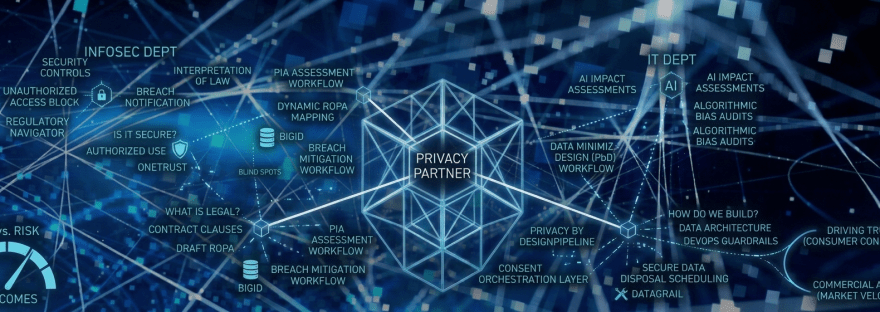
Beyond the Blind Spots: How a Privacy Partner Operationalizes Compliance

In mid-sized organizations, privacy responsibilities are often assigned to the IT Director, CISO, or General Counsel. These roles bring deep expertise in technology, security, and legal compliance. However, privacy introduces an additional discipline that focuses on how information is used, whether that use aligns with stated purposes, and how those decisions are operationalized across systems.

Two structural challenges commonly emerge:

  1. Privacy governs data use, not only data protection.
    As privacy regulations expand and organizations increase their use of AI and data-driven systems, compliance depends on clearly defined purposes, permissions, and lifecycle controls—not solely on security safeguards.
  2. Regulatory obligations require repeatable operations.
    Many privacy requirements depend on consistent execution (e.g., responding to individual rights requests, maintaining processing records). When these activities are handled manually or distributed across functions, they create operational risk and inefficiency.

As a result, privacy increasingly functions as an operational capability rather than a policy-only responsibility.

In this environment, organizations often supplement internal expertise with external privacy partners to address gaps between regulatory interpretation and system-level execution. These partners do not replace internal accountability, but support leadership by translating privacy requirements into operational processes aligned with existing IT, security, and business workflows.

In this context, privacy is no longer limited to published notices or contractual language. It is a data lifecycle and systems management challenge requiring coordinated execution across legal, technical, and business teams.

Governance Context: Roles and Accountability

From a governance perspective, privacy responsibilities typically align with a Three Lines of Defense model:

  • First Line (Business & IT Operations):
    Own data use, system design, and day‑to‑day processing activities.
  • Second Line (Privacy, Risk, Compliance):
    Define requirements, provide guidance, monitor adherence, and maintain oversight documentation.
  • Third Line (Audit / Independent Assurance):
    Validate that privacy controls and processes operate as designed.

Where organizations lack a dedicated internal privacy function, an external privacy partner commonly supports the second line by providing subject‑matter expertise, standardizing processes, and supporting oversight without assuming operational ownership.

1. Operationalizing Privacy Requirements

Regulatory requirements must be translated into documented, repeatable processes. Without this translation, organizations rely on ad hoc responses when regulators, customers, or partners request information.

In practice, external privacy expertise is often used to help establish these processes in a consistent and auditable manner.

Key operational areas include:

• Record of Processing Activities (ROPA)
A compliant ROPA requires more than an inventory of systems. It must link data sets to processing purposes, legal bases, and retention decisions. Where internal teams maintain fragmented documentation, external privacy support can help normalize ROPA structures and ensure alignment with actual system behavior. When purposes change or expire, associated data should be reviewed and disposed of to reduce long-term risk.

• Data Subject Requests (DSRs)
Rights such as access, deletion, and correction are time-bound and resource-intensive when handled manually. Standardized workflows—often designed with external privacy input—can support consistent intake, identity verification, and fulfillment across systems while improving response reliability and cost predictability.

• Consent Management
Consent requirements span websites, mobile applications, CRM systems, and marketing platforms. Effective consent management depends on synchronized preferences and a consistent source of record. External privacy expertise is frequently used to help define consent governance models and ensure downstream systems respect user choices across platforms.

• Privacy Impact Assessments (PIAs / DPIAs)
PIAs are most effective when conducted early in the system development lifecycle. Privacy specialists—internal or external—can assist development and product teams by identifying risks at design time, enabling mitigation through architectural decisions rather than post‑deployment remediation.

• Data Minimization and Disposal
Retention decisions affect legal exposure, breach impact, and discovery obligations. Operationalizing retention and disposal policies often requires coordination between legal, IT, and security teams. External privacy support can help align retention rules with technical enforcement mechanisms to ensure policies are applied consistently.

2. Privacy Technology and Tool Selection

When privacy responsibilities are distributed across functions, tool selection is often fragmented. Different stakeholders may prioritize integration, reporting, or usability, leading to overlapping or underutilized solutions.

A coordinated approach to privacy tooling—frequently supported by external privacy advisors—focuses on selecting and integrating platforms that support:

  • Governance, risk, and compliance reporting across jurisdictions
  • Automated data discovery and classification
  • Scalable fulfillment of individual rights requests
  • Integration with development, security, and IT service workflows

The primary objective is not tool adoption itself, but operational integration. Privacy activities should surface within existing workflows and control environments so that compliance obligations are met as part of normal operations rather than through parallel processes.

3. Privacy in AI and Advanced Analytics

As organizations deploy AI and machine learning systems, privacy considerations increasingly intersect with model development, data governance, and risk management.

Key considerations include:

  • Documenting data provenance and permissible use
  • Assessing whether training and inference data align with stated purposes
  • Evaluating risks related to repurposing, bias, and downstream use

Given the evolving regulatory environment, organizations frequently rely on specialized privacy expertise to support AI impact assessments and governance reviews. These assessments help leadership determine whether proposed data uses are permissible, defensible, and sustainable over time.

Summary 

Assigning privacy responsibility without dedicated operational ownership can introduce long-term compliance and operational risk. Whether delivered internally or supported by external expertise, a structured privacy function enables:

  • IT teams to design and operate systems with clear data‑use constraints
  • Security teams to reduce exposure through minimization and controlled access
  • Legal and compliance teams to rely on documentation that reflects actual operational practices

When privacy requirements are embedded into systems, governance structures, and risk frameworks, organizations are better positioned to respond to regulatory inquiries, support data‑driven initiatives, and adapt to evolving legal standards.

CCPA, CDO, CPO, GDPR, IAPP, Privacy, Risk management

Building a Simplified Privacy Program in Business

The rules around protecting the privacy of customer and employee data are becoming one of the most complex business risks (not necessarily highest risk). With no single federal law, organizations face a complicated patchwork of state regulations (like those in California and Virginia), all while new Artificial Intelligence (AI) rules are beginning to overlap and add even more complexity.

This paper cuts through that complexity. It presents a simple, practical framework for a modern privacy program, focusing on the essential “what” must be achieved, not the highly detailed “how.” The goal is a program that is easy to understand, aligned with business strategy, and nimble enough to keep up with the law.

Three Pillars of a Resilient Privacy Program

To ensure continuous compliance, managing risk, and ready to respond, privacy programs can be thought of as built on three essential, functional pillars: Steady State, Change Management, and Response.

I. Steady State: The Foundation of Continuous Compliance

This pillar is about maintaining a clear, current understanding of what data is on hand and what can be donr with it. It focuses on the recurring activities that maintain compliance day-to-day.

Key ComponentWhat It Does for the Business
Inventory of Data and ProcessesWhat personal data is collected, why, and where is it stored. What permissions are attached to it? This is the single most critical piece of information, as it dictates all other requirements (e.g., disposal deadlines, security needs).
Inventory of ObligationsA clear view is needed of all applicable regulatory requirements (e.g., state laws) and contractual agreements (e.g., what promises are made to clients or what vendors commit to do).
Third-Party Risk Management (TPRM)Vendors and partners are a disproportionate source of privacy risk. A formal process is needed to assess how they handle data, which is often overlooked in favor of standard IT security checks.
Risk and ControlsAreas of greatest exposure must be identified and proportionate safeguards in must be put in place. This includes employee training and technical controls to limit who can access sensitive data.
Incident ResponseA formal plan for responding to privacy breaches or misuse of data is essential. This allows for quick action, remediation of vulnerabilities, and the ability to meet strict regulatory notification deadlines to minimize reputational and financial harm.

II. Change: Integrating Privacy by Design

This pillar proactively manages new risks that emerge in connection with new products, services, or large projects. It ensures that privacy is a fundamental design element, not a reactive checklist at the end.

Key ComponentWhat It Does for the Business
Privacy Impact Assessments (PIAs)This is the mandatory checkpoint for “Privacy by Design.” It’s a formal analysis to determine if a new initiative poses a high risk, ensuring the Privacy team is engaged early in the development cycle, long before launch.
Regulatory Change ManagementThe legal landscape is constantly changing. It suggests a formal process to monitor new laws, determine their impact, and implement necessary control changes before they take effect.
Process and Control ChangesA mechanism to engage the privacy team when business or IT process changes impact how personal data is handled. This prevents unauthorized, or “shadow,” changes from introducing new vulnerabilities.

III. Response to Inquiry: Demonstrated Accountability

This pillar focuses on the auditable evidence and response mechanisms that prove the program is working and demonstrate transparency to both regulators and data subjects (i.e., customers/employees).

Key ComponentWhat It Does for the Business
Data Subject Rights (DSR) ManagementPeople have a legal right to ask us what personal data an organization has have on them and how they’re using it.  This drives the need for a streamlined, auditable workflow to intake these requests, verify identities, and fulfill them within strict regulatory deadlines.
Regulator RequestsOn occasion, a regulator may inquire about a privacy program. Having a clear response plan is necessary to efficiently provide the required evidence and documentation, often leveraging the data from the Inventory and the DSR process.
Measurement and Continuous ImprovementTracking certain operational metrics is key (e.g., number of incidents, time to fulfill DSRs) to monitor the effectiveness of the program and identify areas that require management focus and resource investment.

Executive Summary

The growing complexity of US privacy law demands a highly organized and resilient compliance framework. To navigate this challenge, we must focus on structure (the three functional pillars), process management, and enabling technology.

By proactively investing in and leveraging specialized privacy technology platforms, management of these intricate requirements can be automated. This approach achieves defensible compliance while keeping operational costs managed, allowing the business to drive forward with reduced risk.

CPO, Privacy, Uncategorized

Overcoming the Privacy Complexity Trap: Right-Sizing Privacy for Strategic Advantage

The modern corporate privacy program, especially within mid-size enterprises, has inadvertently evolved into a major source of operational complexity, frustration and friction, often disproportionate to the actual regulatory risk it seeks to mitigate. Instead of being designed as a streamlined risk management function, programs frequently become bloated, slow, with checklist-driven mandates built to satisfy the compliance demands of every fragmented state law individuallyand equally. This approach leads to “checklist paralysis,” diverting excessive time and budget towards documentation and reviews rather than focusing resources on the small subset of truly high-risk, sensitive data—the company’s “crown jewels.” The result is a system that is overly expensive, strategically inflexible that creates tension between the mission-oriented departments (development, sales, delivery) and the control-oriented groups (risk, compliance, legal).

To combat this complexity, organizations must pivot from a purely centralized compliance model to a hybrid that includes distributed, risk-balanced privacy program execution. This alternative design requires strategically moving certain privacy activities out of a central department and embedding them within the business functions that create, gather, storeand process data.

The foundation of this distributed model rests on three pillars of activity across the organization:

  1. Strategic Governance (Central Team): The central function shrinks to focus only on program stewardship, high-level policy, external regulatory change monitoring, risk modeling, and overall accountability. It defines the “what” and “why.”
  2. Embedded Privacy-by-Design (Engineering/Product): Department-level individuals are trained to own the initial privacy decisions (with consultation where necessary). They are responsible for implementing data protection, data minimization and purpose limitation controls at the system design level, making the program proactive rather than reactive. This operationalizes the core tenets of the principles-based framework directly into the creation of new products and services.
  3. Automated Execution (Operations/IT): This is where Privacy Management Platforms (PMPs) become the essential enabler of the right-sized program. Cloud-based PMPs distribute the workload for high-volume, repetitive, and resource-intensive tasks without distributing the risk.

By leveraging these platforms, a company can automate the most common compliance burdens: maintaining automated data inventories, standardizing and deploying consent banners, and managing the workflow for Data Subject Access Requests (DSARs). This automation drastically reduces the risk and the need for expensive, manual labor—the biggest driver of complexity and cost—allowing the distributed staff to focus on genuine innovation and high-value risk mitigation.

In conclusion, right-sizing a privacy program requires a strategic trade-off: trading centralized control for decentralized accountability, and trading manual compliance for automated execution. This approach removes unnecessary friction, lowers operational costs, and transforms privacy from a bureaucratic hindrance into a sustainable, competitive edge that fosters enduring customer trust.