
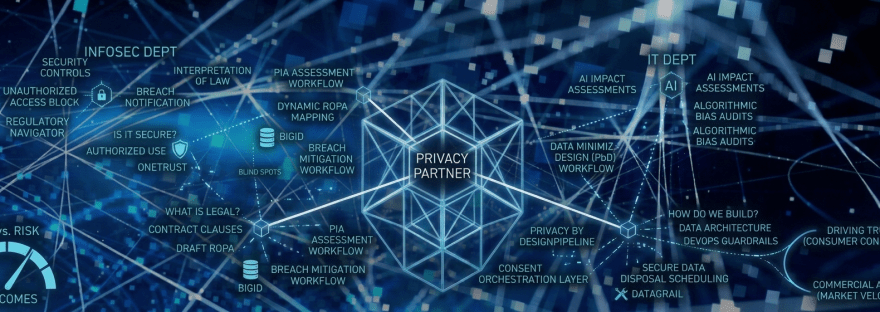
In mid-sized organizations, privacy responsibilities are often assigned to the IT Director, CISO, or General Counsel. These roles bring deep expertise in technology, security, and legal compliance. However, privacy introduces an additional discipline that focuses on how information is used, whether that use aligns with stated purposes, and how those decisions are operationalized across systems.
Two structural challenges commonly emerge:
- Privacy governs data use, not only data protection.
As privacy regulations expand and organizations increase their use of AI and data-driven systems, compliance depends on clearly defined purposes, permissions, and lifecycle controls—not solely on security safeguards. - Regulatory obligations require repeatable operations.
Many privacy requirements depend on consistent execution (e.g., responding to individual rights requests, maintaining processing records). When these activities are handled manually or distributed across functions, they create operational risk and inefficiency.
As a result, privacy increasingly functions as an operational capability rather than a policy-only responsibility.
In this environment, organizations often supplement internal expertise with external privacy partners to address gaps between regulatory interpretation and system-level execution. These partners do not replace internal accountability, but support leadership by translating privacy requirements into operational processes aligned with existing IT, security, and business workflows.
In this context, privacy is no longer limited to published notices or contractual language. It is a data lifecycle and systems management challenge requiring coordinated execution across legal, technical, and business teams.
Governance Context: Roles and Accountability
From a governance perspective, privacy responsibilities typically align with a Three Lines of Defense model:
- First Line (Business & IT Operations):
Own data use, system design, and day‑to‑day processing activities. - Second Line (Privacy, Risk, Compliance):
Define requirements, provide guidance, monitor adherence, and maintain oversight documentation. - Third Line (Audit / Independent Assurance):
Validate that privacy controls and processes operate as designed.
Where organizations lack a dedicated internal privacy function, an external privacy partner commonly supports the second line by providing subject‑matter expertise, standardizing processes, and supporting oversight without assuming operational ownership.
1. Operationalizing Privacy Requirements
Regulatory requirements must be translated into documented, repeatable processes. Without this translation, organizations rely on ad hoc responses when regulators, customers, or partners request information.
In practice, external privacy expertise is often used to help establish these processes in a consistent and auditable manner.
Key operational areas include:
• Record of Processing Activities (ROPA)
A compliant ROPA requires more than an inventory of systems. It must link data sets to processing purposes, legal bases, and retention decisions. Where internal teams maintain fragmented documentation, external privacy support can help normalize ROPA structures and ensure alignment with actual system behavior. When purposes change or expire, associated data should be reviewed and disposed of to reduce long-term risk.
• Data Subject Requests (DSRs)
Rights such as access, deletion, and correction are time-bound and resource-intensive when handled manually. Standardized workflows—often designed with external privacy input—can support consistent intake, identity verification, and fulfillment across systems while improving response reliability and cost predictability.
• Consent Management
Consent requirements span websites, mobile applications, CRM systems, and marketing platforms. Effective consent management depends on synchronized preferences and a consistent source of record. External privacy expertise is frequently used to help define consent governance models and ensure downstream systems respect user choices across platforms.
• Privacy Impact Assessments (PIAs / DPIAs)
PIAs are most effective when conducted early in the system development lifecycle. Privacy specialists—internal or external—can assist development and product teams by identifying risks at design time, enabling mitigation through architectural decisions rather than post‑deployment remediation.
• Data Minimization and Disposal
Retention decisions affect legal exposure, breach impact, and discovery obligations. Operationalizing retention and disposal policies often requires coordination between legal, IT, and security teams. External privacy support can help align retention rules with technical enforcement mechanisms to ensure policies are applied consistently.
2. Privacy Technology and Tool Selection
When privacy responsibilities are distributed across functions, tool selection is often fragmented. Different stakeholders may prioritize integration, reporting, or usability, leading to overlapping or underutilized solutions.
A coordinated approach to privacy tooling—frequently supported by external privacy advisors—focuses on selecting and integrating platforms that support:
- Governance, risk, and compliance reporting across jurisdictions
- Automated data discovery and classification
- Scalable fulfillment of individual rights requests
- Integration with development, security, and IT service workflows
The primary objective is not tool adoption itself, but operational integration. Privacy activities should surface within existing workflows and control environments so that compliance obligations are met as part of normal operations rather than through parallel processes.
3. Privacy in AI and Advanced Analytics
As organizations deploy AI and machine learning systems, privacy considerations increasingly intersect with model development, data governance, and risk management.
Key considerations include:
- Documenting data provenance and permissible use
- Assessing whether training and inference data align with stated purposes
- Evaluating risks related to repurposing, bias, and downstream use
Given the evolving regulatory environment, organizations frequently rely on specialized privacy expertise to support AI impact assessments and governance reviews. These assessments help leadership determine whether proposed data uses are permissible, defensible, and sustainable over time.
Summary
Assigning privacy responsibility without dedicated operational ownership can introduce long-term compliance and operational risk. Whether delivered internally or supported by external expertise, a structured privacy function enables:
- IT teams to design and operate systems with clear data‑use constraints
- Security teams to reduce exposure through minimization and controlled access
- Legal and compliance teams to rely on documentation that reflects actual operational practices
When privacy requirements are embedded into systems, governance structures, and risk frameworks, organizations are better positioned to respond to regulatory inquiries, support data‑driven initiatives, and adapt to evolving legal standards.




 J. Howard, CDO & CPO