
Banner reading “Moving the Dot: Where AI pays off in a privacy program,” with a glowing dot traveling along an arc across an abstract blue network toward the J.H. logo.
CCPA, CPO, GDPR, IAPP, Privacy, Privacy & data protection, Regulatory Compliance, Risk management

Moving the Dot: Where AI Pays Off in a Privacy Program

Executive Summary

Privacy programs have never been funded for full coverage. They close the gap between what the law requires and what they can afford by accepting risk. As pressure on obligations owed to individuals and regulators rises,1 that trade-off is becoming untenable.

AI changes the equation. Applied to four foundations of the program, and built on investments the enterprise has already made plus a targeted privacy layer, it acts as a force multiplier. It lets organizations reduce the risk they accept without a proportional increase in cost, provided it is managed as a control.

What You Will Gain From This Article:

1. Why Can’t Privacy Programs Cover Everything?

Meeting every statutory obligation and addressing every inherent risk has traditionally required more people than can be cost-justified. Programs close the gap the only way they can: they cover the highest-priority obligations well and tolerate gaps elsewhere. That gap is residual risk that has been accepted, often by default rather than by decision. And where it is a decision, it is often made by people with little real choice: privacy leaders without the budget or influence to close the gap.

Over time, that acceptance drifts. The question quietly shifts from “are we compliant?” to “how likely are we to be caught, or to cause harm?” That is an enforcement calculation, not a compliance one. It is rarely made explicitly, and it rarely survives an audit finding, a regulatory inquiry or an incident.

The economics have held because the only way to add coverage was to add people. AI changes that. Work that once required headcount, such as reading, classifying, searching and drafting, can now be multiplied, so less risk has to be accepted for the same cost.
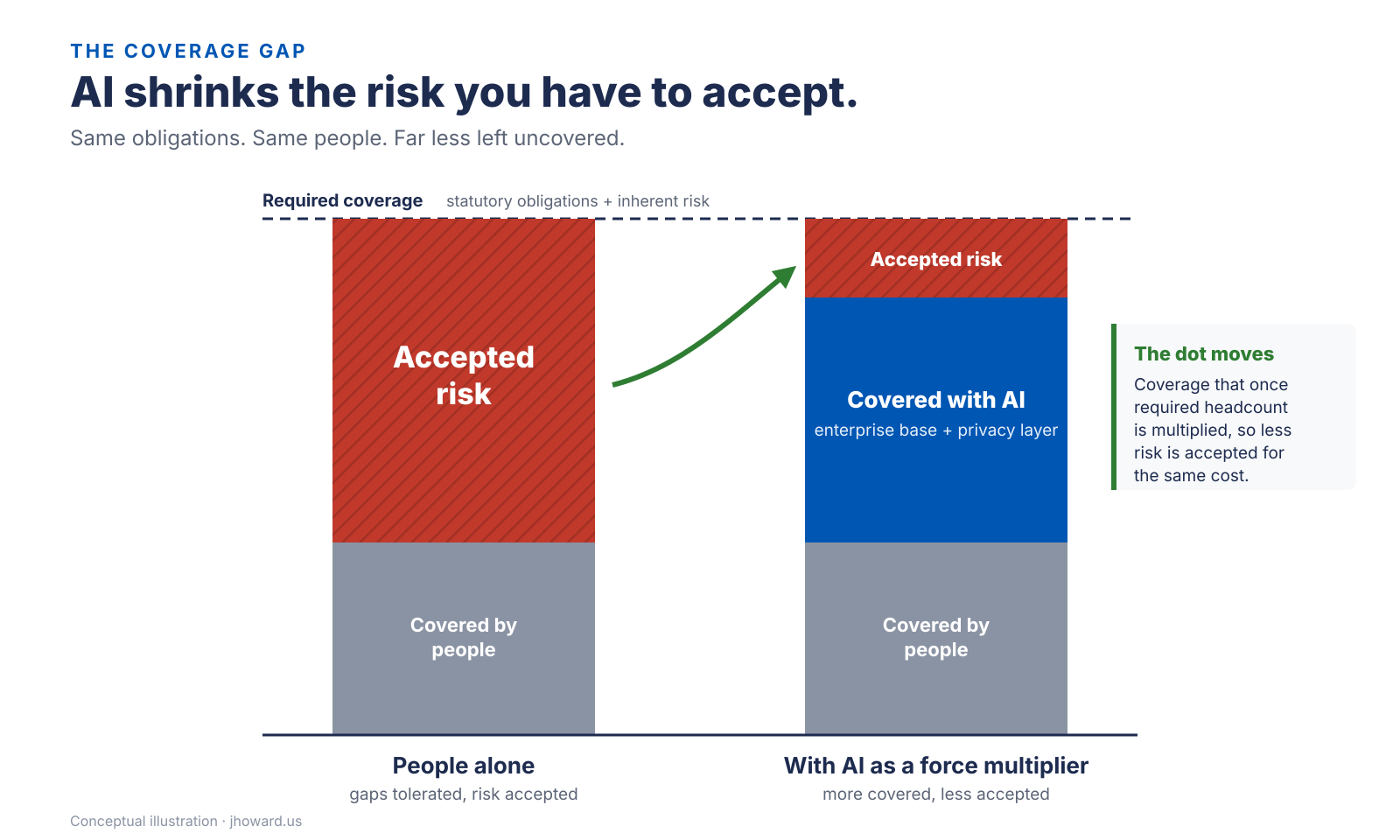
Two bars of the same required privacy coverage. With people alone, a large red block of accepted risk sits above a gray block covered by people. With AI as a force multiplier, a blue block covered with AI fills most of that space, leaving only a thin band of accepted risk.
Figure 1. The coverage gap: same obligations, same people, far less risk accepted.

2. Why Is the Gap Getting Harder to Sustain?

The gap is getting harder to sustain, particularly on the obligations side.

Rights requests are growing in volume, complexity and consequence. Individuals now use generative AI to draft long, legally sophisticated requests in seconds,2 and requests are increasingly organized: some are filed in bulk to gather material for litigation, and some opportunistically, to provoke a failure and claim compensation. Europe’s highest court confirmed in 2026 that a mishandled access request can itself give rise to compensation, even where the underlying processing was lawful.3 Every request, however it was drafted or organized, carries a deadline that runs from the day it arrives.

Incident rules keep tightening. The SEC’s amended Regulation S-P requires a written incident response program and notice to affected individuals within 30 days,4 joining the GDPR’s 72-hour regulator notification and a patchwork of state laws. Meeting those deadlines depends on knowing quickly whose data was affected and which rules apply.


3. What Are the Four Foundations, and Where Do They Sit?

Four foundations carry most of the obligations load, and they are not independent.

Two are reference foundations:

  • The data inventory tells the organization what data it holds, where it sits, and how to find a specific person’s records.
  • The rights and preferences profile tells it what each individual is entitled to and what they have chosen: consents, opt-outs, objections.

The other two are processes that depend on them:

  • Privacy by design (PbD) and privacy impact assessments govern change. PbD conveys privacy requirements before development begins, drawing on both reference foundations. The PIA confirms, after development and before launch, that those requirements were met.
  • DSR and incident response query both to define what must be searched, retrieved, disclosed or notified, and by when.
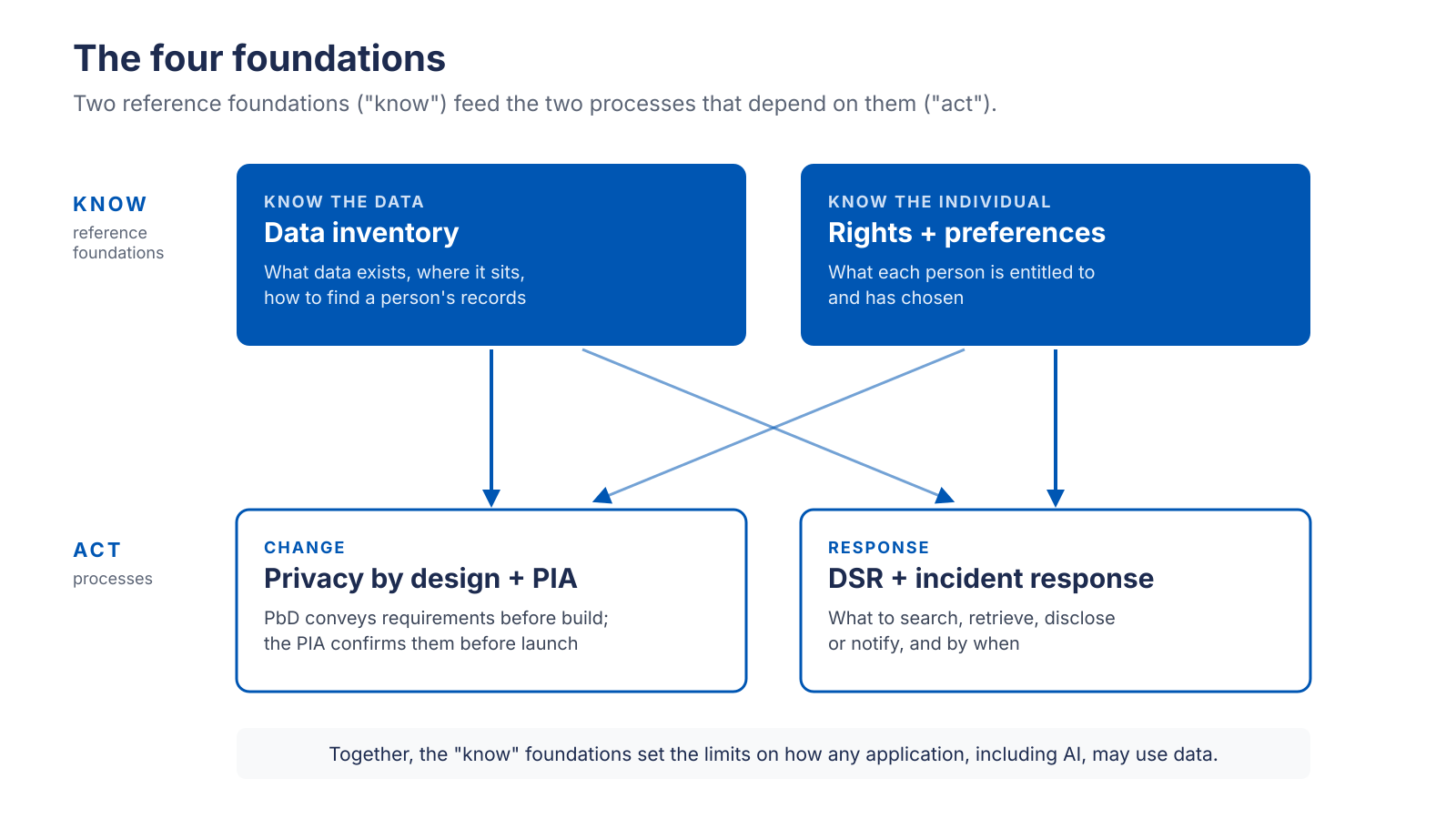
Diagram of the four foundations. Two reference foundations at the top, the data inventory (know the data) and rights and preferences (know the individual), each feed down into two processes below: privacy by design and PIA (change) and DSR and incident response (response).
Figure 2. The two “know” foundations feed the two “act” processes.

Plot each foundation by its residual risk and operating cost. Residual risk measures where each foundation sits; accepted risk is the part of it the organization is choosing to live with.

The Risk-Cost Matrix
Lower cost Higher cost
Higher risk Hidden exposures: cheap because under-resourced, not because well-run Pressure points: manual, high-volume, deadline-driven
Lower risk Steady state: standardized, automated, monitored Overbuilt: effort out of proportion to the risk it manages

In many organizations, the foundations sit like this:

  • Data inventory is often a hidden exposure: manual, rarely current, and too costly to cover the full breadth of the organization’s data. Application inventories often serve as a proxy, but their narrow view doesn’t support a common taxonomy or enterprise-wide classification.
  • Rights and preferences are often a hidden exposure, scattered across systems and markets. That’s cheap until an opt-out isn’t honored or a request is scoped incorrectly.
  • PbD and PIAs are often a hidden exposure that becomes a pressure point. Without requirements up front, issues surface late, and manual PIAs struggle to keep pace with Agile delivery. They are completed after the fact, forcing costly redesign (or more risk acceptance), or not at all, leaving a blind spot.
  • DSR and incident response are the pressure points: high-volume, deadline-driven, and inheriting every weakness in the reference foundations.

The hidden exposures are where risk acceptance lives. The pressure points are where it fails first. Rising pressure pushes every foundation up and to the right. The objective is to move them back, down and to the left.
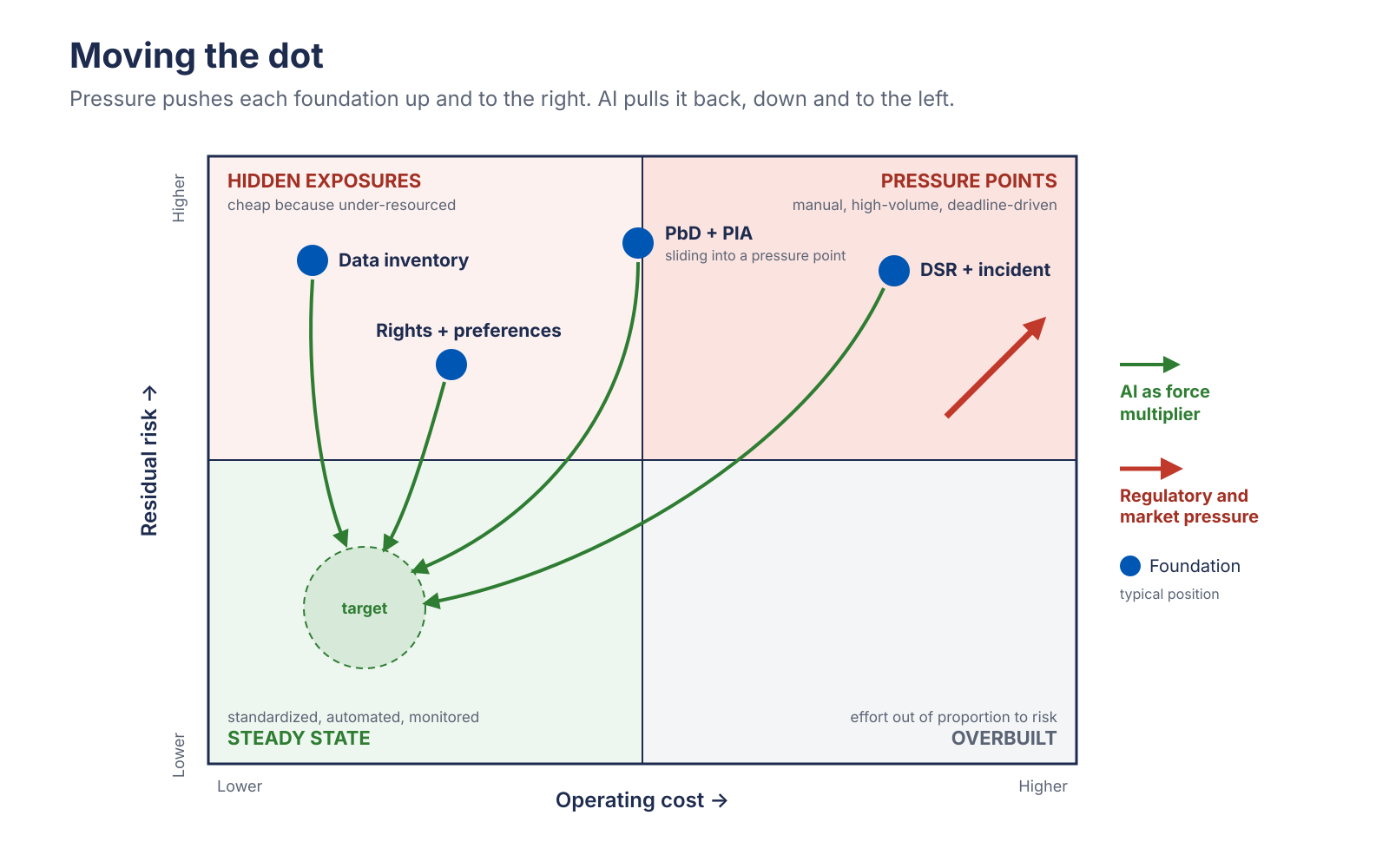
Risk-cost matrix with four quadrants: hidden exposures, pressure points, steady state and overbuilt. The data inventory and rights and preferences sit in hidden exposures, PbD and PIA on the border sliding into pressure points, and DSR and incident in pressure points. A red arrow shows regulatory and market pressure pushing up and to the right; green arrows show AI pulling each foundation toward a steady-state target.
Figure 3. Moving the dot: pressure pushes up and to the right; AI pulls back toward steady state.

4. How Does AI Change the Equation?

Most of the cost in a privacy program comes from people reading things: system documentation, call transcripts, emails, request letters, incident reports. AI is good at exactly that work. It can classify data, interpret a sprawling request, flag a likely rights request in a chat transcript, or draft a first-pass assessment, all for a person to confirm.

The enterprise is probably already paying for much of the capability. Security teams have invested in data discovery and incident management. Data teams run catalogs and lineage tools. Contact centers use speech and text analytics. Legal owns eDiscovery. Delivery teams run Agile tooling. Most organizations now license an enterprise AI platform.

But these were built for other purposes, and they rarely meet privacy’s needs on their own. A data catalog knows where data sits, not who it belongs to, what each person has permitted, or how long it may be kept. Incident management is traditionally owned by information security, with privacy running in parallel or added on afterward. The practical model is to leverage the enterprise base and add a privacy layer, which often means targeted investment in privacy management tools that bring privacy context to the platforms the organization already runs.

AI as a Force Multiplier: Leverage the Base, Add a Privacy Layer
Foundation What AI does Enterprise base to leverage Privacy layer to add
Data inventory Scans systems, classifies personal data, maps it to a common taxonomy, keeps it current Data catalogs and lineage, data security posture management, application inventories Privacy taxonomy and classification; links to individuals, purposes, legal bases and retention
Rights and preferences Interprets free-text requests and preferences, matches identities; rights determination stays rule-based Customer platforms, identity services A rights and preferences engine: jurisdictional rules, consents and opt-outs, propagated to applications
PbD and PIAs Generates requirements at intake; scans code for use of personal data and reconciles it with permitted purposes; embeds a short assessment in delivery tools; triages risk; drafts findings Enterprise AI platform, Agile and workflow tools, code repositories and CI/CD pipelines, GRC Privacy requirements library and assessment workflow integrated with delivery, linked to the inventory and rights and preferences
DSR and incident response Detects requests in calls, chats and mailboxes; automates retrieval; proposes redactions; reviews incidents for privacy impact Contact-center analytics, eDiscovery, security incident management, case management DSR orchestration; privacy impact triage and notification rules within the incident process

In each case, AI moves the foundation down and to the left: the enterprise base keeps cost down, and the privacy layer makes the risk reduction real. AI pays off first in the reference foundations, because every downstream process draws on them. Automating response on top of weak foundations simply produces wrong answers faster.

Privacy leaders see the opportunity but are moving cautiously. In a small 2026 benchmark, privacy ranked first of eleven functions on automation ambition and near last on trust in AI.5 Notably, the AI these leaders trust and use most is the AI embedded in enterprise platforms they already run, which is where the practical path begins.


5. How Should AI Itself Be Managed?

Using AI in a privacy program is defensible, and increasingly expected, but it introduces risks of its own: it processes personal data (including employees’), models make mistakes, third-party services raise disclosure and data-location questions, and AI regulation is evolving quickly.

AI is an assistant, not a decision-maker, and it must be managed like any other control:6

  • Foundations first. AI amplifies whatever it is built on.
  • Human in the loop for disclosures, denials, deletions, notifications and assessment outcomes.
  • Purpose limitation, with no drift into performance management or marketing.
  • Accountability for every AI tool: a defined role and limited permissions, a named owner, a record of what it did, and the ability to stop it quickly.
  • Architecture by design: run AI where the data already sits, and account for data location and emerging AI rules.

6. What Should Executives Do Now?

  1. Make the risk acceptance explicit, and elevate it. Identify where coverage gaps are being tolerated, whether that is a compliance decision or an enforcement calculation, and bring material acceptances to the operating or management committee and the board, where the authority to fund or accept them sits.
  2. Plot the foundations on the matrix using real indicators: request volumes, cycle times, missed deadlines, late or skipped assessments, audit findings.
  3. Inventory what you already own, and identify the privacy layer each needs: the catalog, security, analytics, eDiscovery, delivery and AI platforms the enterprise has funded.
  4. Strengthen the reference foundations first.
  5. Accelerate the pressure points with named workflows, starting with DSR and incident response and bringing PbD and PIAs onto the delivery critical path.
  6. Measure the movement: cost per request, cycle times, inventory coverage, PIAs completed before launch, and the risk no longer being accepted.

Two Questions for Boards and Audit Committees

  1. Where is our privacy program accepting risk today, and who decided?
  2. Which enterprise investments could support privacy, and what privacy layer would they need?

Conclusion: Moving the Dot

For years, privacy programs have balanced what the law requires against what they can afford, and closed the difference with risk acceptance. Rising pressure is making that balance harder to hold. AI does not eliminate the trade-off, but it changes its terms.

Built on strong foundations, investments the enterprise has already made and a targeted privacy layer, it lets organizations cover more while accepting less risk, without a matching rise in cost. Organizations that manage it well will respond faster, see their data more clearly, and earn the trust that turns privacy into a competitive advantage.


Notes

  1. This article focuses on obligations owed to individuals and regulators: rights, consent, change and incident response. Rising complexity affects program design and cost more broadly. New requirements must be translated into processes and applications across the enterprise, and programs also carry the cost of notices, third-party oversight, cross-border transfers, training and governance reporting. The same force-multiplier logic applies to many of these, but they warrant separate treatment. ↩
  2. Ireland’s Data Protection Commission reported more than 16,000 contacts in 2025, a 45% increase on the prior year, and noted that access requests are increasingly long and AI-generated. Data Protection Commission, Annual Report 2025. ↩
  3. Court of Justice of the European Union, Brillen Rottler GmbH & Co. KG v TC, Case C-526/24, judgment of 19 March 2026. The Court also held that clearly abusive requests may be refused, but only on evidence, and that refusing a first request should remain exceptional. ↩
  4. U.S. Securities and Exchange Commission, amendments to Regulation S-P (adopted May 2024). Larger covered entities were required to comply by December 3, 2025, and smaller entities by June 3, 2026. ↩
  5. Assemble, The State of AI in Data Privacy, Decision Intelligence Benchmark special report (survey of 26 data privacy leaders, February–March 2026). ↩
  6. AI proposes, people decide, accuracy is measured, and changes follow model governance. Organizations can keep AI close: on-premises, within their own cloud environment, or inside platforms they already use. They can also tailor it to internal data. Retrieval, where the model reads internal data at the moment of use, keeps personal data out of the model itself. Fine-tuning on personal data embeds it in the model, making the model a new repository that must be inventoried, secured and subject to individuals’ rights. As AI use grows, the reference foundations should extend to training data, models and agents. ↩

J. Howard logo

James I. Howard

CPO & Privacy Advisor

james@jhoward.us · More articles →

Abstract digital network diagram showing a combined shield and AI brain hub interconnected with data privacy, security, and risk icons.
AI Governance, financial services, Privacy & data protection, Regulatory Compliance

Pragmatic Convergence: Building a Lean Privacy and AI Governance Program for Broker-Dealers

Executive Summary

For years, financial services compliance playbooks were written by and for commercial banks. But broker-dealers (B-Ds) are fundamentally different: fast-moving, sales-driven, transactional, and notoriously lean. They view heavy, bureaucratic compliance structures as growth-throttling cost centers and reject massive capital expenditure on defensive software.

Today, B-Ds face a double-barreled threat: meeting strict new privacy mandates like the SEC’s amended Regulation S-P 30-day incident reporting rule, while simultaneously managing rapid, unvetted AI adoption across trading and sales desks.

The solution is not two separate compliance programs, nor is it simply overlaying AI checks onto legacy silos. The real answer is native operational convergence. By architecting data privacy and AI governance into a single operating engine led by a single accountable leader, B-Ds achieve complete regulatory coverage and advisor agility at a fraction of the cost.

What You Will Gain From This Guide:
  • The B-D Divergence Map: Why bank models fail, why governance requires a triangulation of Data, Tech, and Leadership, and why native transformation beats overlaying tech.
  • The Bidirectional Convergence Lens: How Privacy and AI Governance blend seamlessly from both directions, whether starting with data protection or model risk, and how to harness AI’s revenue-generating momentum.
  • A 5-Pillar Operational Blueprint: Includes a single accountable lead (“throat to choke”), embedded change management, a full 10-question unified PIA/AIA intake with human audits, concrete opt-out mechanics, global regulatory alignment, and accelerated 24 to 72-hour incident SLAs.
  • Advisor Buy-In & Dual Liability: How to protect both the firm and advisor under Reg BI while maintaining open channels with a strict 24 to 48-hour review SLA.
  • Tooling Leverage: How modern Privacy Management Platforms (PMPs) give lean teams the leverage to run a multi-domain program without inflating headcount.

1. Will Copying a Bank’s Privacy Playbook Work at Your Broker-Dealer?

To build a workable privacy program for a broker-dealer, you must first abandon the bank compliance blueprint:

Attribute Commercial Banks Broker-Dealers (B-Ds)
Business Model Slow-moving, relationship & balance-sheet heavy. Fast, transactional, market-driven, and sales-dependent.
Culture Risk-averse; structured “Three Lines of Defense.” Entrepreneurial, fast-paced, protective of client relationships.
Compliance Scale Large, multi-million dollar privacy & risk teams. Lean compliance teams where CCOs “wear five hats.”
Data Footprint Deep, long-term credit histories and deposits. High-velocity trading logs, portfolio data, suitability records, and chat logs.

The Triangulation of Governance: Data, Tech, and Leadership

Many compliance leaders observe that “AI risk is data risk.” While true, that view is incomplete. Data provides the raw fuel, Technology provides the algorithmic engine, but Leadership provides the strategic intent, risk boundary, and accountability. Without proactive leadership, data protection and tech innovation pull the organization in opposite directions.

Native Transformation vs. Passive Overlays

Most firms make the mistake of retaining legacy, siloed B-D workflows and simply overlaying AI governance checks on top of existing privacy rules. Layering duplicate controls onto existing silos creates bureaucratic friction and delays innovation. Forward-thinking B-Ds must natively transform their operational architecture. Data privacy and AI risk management should be built into core software procurement, data ingestion, and sales enablement workflows from day one, establishing a unified compliance posture by default.


2. Why Is Separating Data Privacy and AI Governance a Costly Mistake?

Building separate Privacy and AI Governance programs is financially and operationally non-viable for a lean B-D. Because both domains govern how data is captured, analyzed, shared, and stored, combining them into a single engine creates immediate operational synergy.

Convergence Architecture: Blending Data Privacy & AI Governance
Architecture Tier Risk & Governance Focus Key Operational Elements
1. Foundational Layer Unified Data & AI Catalog Single inventory mapping NPI data repositories alongside internal and vendor AI models.
2. Parallel Risk Domains Privacy Risk Domain
• Reg S-P Compliance
• Consent & Disclosures
• Data Minimization
AI Governance Domain
• Algorithmic Bias & Drift
• IP & Prompt Leakage
• Model Hallucinations
3. Integrated Control Engine Combined PIA / AIA Intake 10-question intake evaluating privacy rights, vendor training limits, suitability, human audits, and data purging.

The Bidirectional Blend: What If AI Governance Came First?

In practice, when organizations deploy artificial intelligence, AI controls are built in a completely separate silo. They are rarely retrofitted into privacy frameworks because business leaders fail to recognize the shared data-risk space between AI and privacy.

Furthermore, AI possesses a dual nature that traditional privacy lacks: AI has a major business dimension (revenue generation, advisor productivity, and sales alpha) alongside a risk and compliance perspective. Privacy, by contrast, is historically viewed by executives purely as a defensive, cost-center burden.

Understanding this commercial pull changes how governance should be architected. When a firm establishes AI Governance first, driven by business eagerness to deploy generative sales tools or predictive trading algorithms, the technical controls required to manage AI risk naturally satisfy core privacy obligations:

  • Model Lineage Demands Data Lineage: Ensuring an AI model produces compliant recommendations requires knowing what dataset trained it. Fulfilling this AI risk mandate automatically maps customer Non-Public Personal Information (NPI), solving the hardest part of privacy data discovery.
  • Context Windows Demand Data Minimization: Restricting the personal data fed into an LLM’s prompt window to prevent hallucination and prompt leaks directly enforces the foundational privacy principle of data minimization.
  • Algorithmic Transparency Demands Disclosures: Explaining automated rebalancing or predictive wealth algorithms to satisfy FINRA and SEC suitability rules creates the exact transparency mechanics needed for state Automated Decision-Making Technology (ADMT) privacy disclosures and international AI mandates.

By capturing the revenue-generating momentum of AI, smart B-Ds can piggyback privacy controls onto AI governance initiatives, turning business ambition into unified compliance leverage.


3. How Do You Build a Lean, Compliant Governance Blueprint on a Tight Budget?

To deliver complete regulatory coverage on a lean budget, B-D compliance leaders should deploy this 5-pillar operational framework:

5-Pillar B-D Governance Blueprint
1. Single Lead & Change Council Privacy & AI Lead (Single Point of Accountability) + Change Management Committee
2. Unified Data & Model Catalog Single live inventory for NPI data flows, vendor SaaS, and internal/external AI models
3. Native Consent & Opt-Out Engine Combined Reg S-P notices, state ADMT opt-outs, model training restrictions, and global AI framework alignment (e.g., EU AI Act, Colorado AI Act)
4. Full 10-Question PIA / AIA Intake Integrated intake for Data Minimization, Model Isolation, Suitability, Human Auditing, and Data Purging
5. Accelerated Incident & DSR Engine 24 to 72-hour AI triage SLA + 30-day SEC reporting + FINRA Rule 4511 recordkeeping overrides

Pillar 1: Name a Single Accountable Leader & Change Management Council

Programs fail when there is no single throat to choke. Appoint one executive, a designated Privacy & AI Governance Lead (often a dual-hatted CCO, Head of Operational Risk, or CPO/AIO), to own overall program success.

While this individual does not need to be a machine learning engineer or privacy litigator, they must possess a strong risk management background and a solid grounding in core data privacy and AI governance principles. Equipped with this foundational risk expertise, they leverage modern automated Privacy Management Platforms (PMPs) and chair a monthly Data & Tech Governance Committee composed of the CCO, CTO, Sales/Desk Lead, and Legal counsel.

To keep the framework evergreen, the Lead operates with a small, focused core team working in direct consultation with Legal to maintain a live inventory of applicable laws, rules, and regulations and map them directly into program controls. This core team is responsible for ongoing program maintenance, monitoring operational effectiveness, tracking regulatory shifts, and serving as a central advisory resource for the entire company.

Embedded Change Management: The Committee isn’t just an approval bottleneck; it is a change management engine. It establishes desk-level compliance champions, redesigned workflows that eliminate advisor friction, and active feedback loops to ensure policies fit real-world trading desk realities.

Pillar 2: Maintain a Unified Data & AI Model Catalog

Replace static spreadsheets with a single inventory mapping NPI data stores alongside internal and third-party AI models. Capture data sensitivity, hosting infrastructure, model types (rule-based algorithms vs. generative LLMs), and vendor training rights during initial software onboarding.

Historically, building and maintaining an accurate data inventory has been one of the most tedious and failure-prone exercises for financial services firms, often resulting in abandoned, outdated spreadsheets. Yet maintaining a comprehensive asset inventory is a mandatory regulatory requirement under comprehensive privacy laws, such as GDPR Article 30 (Records of Processing Activities), state privacy statutes like the California Consumer Privacy Act (CCPA/CPRA), and the SEC’s updated Regulation S-P safeguards requiring strict data mapping of Non-Public Personal Information (NPI). The good news is that modern tech tools, specifically Privacy Management Platforms (PMPs) equipped with automated data discovery and cataloging connectors, make building and sustaining a dynamic, live data and AI model inventory far more viable and operationally effortless than ever before.

Pillar 3: Operationalize Consent Architecture, Disclosures, & Global AI Requirements

Consent and preferences form the foundational cornerstone for managing data privacy, assessing incident blast radiuses, and servicing DSRs. If a firm cannot demonstrate valid consent or track preference revocations in real time, it cannot accurately enforce data deletion requests or determine whether an unapproved AI prompt input constitutes a regulatory breach.

This is precisely where the complementary nature of privacy and AI governance becomes clear. B-Ds operating across state or international boundaries must account for emerging AI regulatory frameworks, such as the EU AI Act’s high-risk system obligations, the Colorado AI Act’s algorithmic discrimination prevention rules, and SEC/FINRA risk guidance. Because both domains rely on transparent data handling and user control, operationalizing compliance by embedding consent management, global regulatory disclosures, and preference controls directly into B-D workflows creates a single, mutually reinforcing default posture:

  • Centralized Consent Tracking & DSR Linkage: Capture and log customer privacy preferences, opt-ins, and consent revocations across client portals and onboarding flows. Automatically link consent records to DSR workflows so when a client revokes processing permission or requests deletion, downstream AI pipelines and marketing databases are updated instantly.
  • Incident Scope & Blast Radius Evaluation: In the event of a data spill or AI prompt leak, having centralized, real-time consent metadata allows the Privacy & AI Lead to rapidly determine which clients gave permission for automated processing and which were improperly exposed, substantially reducing regulatory reporting uncertainty.
  • Automated Wealth Profiling (ADMT & AI Laws): Provide clear opt-out mechanisms for state laws governing Automated Decision-Making Technology (ADMT) and emerging AI statutes when algorithms generate automated portfolio rebalancing or risk profiling.
  • Vendor Model Training Opt-Outs: Automatically enforce contractual clauses prohibiting third-party software vendors from ingesting client NPI into their public LLM training datasets without explicit customer consent.
  • Reg S-P Third-Party Sharing: Harmonize annual SEC Reg S-P notices to allow clients to opt out of data sharing with fintech partners utilizing predictive analytics.

Pillar 4: Deploy the Complete 10-Question Integrated PIA / AIA Intake

Traditional compliance programs overwhelm vendors and internal software teams with generic, 40-page security questionnaires that stall software procurement and systems development. In a lean B-D, the tool is the operational delivery engine, while the 10-question intake is the distilled risk logic.

Rather than circulating static spreadsheets, modern Privacy Management Platforms (PMPs) host this 10-question assessment directly within the systems development lifecycle (SDLC) and procurement process. The tool uses conditional logic to automatically trigger the assessment whenever new software, internal system builds, or AI services are requested, scores risk in real time, and automatically populates the firm’s Unified Catalog, replacing bloated legacy paperwork with automated enforcement:

The 10-Question Integrated Privacy & AI Assessment (PIA/AIA)

  1. Data Classification: Does this system ingest, process, or store client Non-Public Personal Information (NPI) or confidential firm data?
  2. Data Minimization: Is the dataset restricted strictly to the minimum fields necessary to achieve the business purpose?
  3. Model Type & Global AI Risk Tier: Does the tool utilize generative AI, Large Language Models (LLMs), or predictive machine learning algorithms, and how is it categorized under frameworks like the EU AI Act or state AI laws?
  4. Vendor Model Isolation: Does the vendor contractually guarantee that firm data will never be used to train their public or multi-tenant models?
  5. Data Location & Boundary: Where is the data processed and hosted (e.g., dedicated private cloud vs. public multi-tenant infrastructure)?
  6. Algorithmic Suitability & Bias: Has the algorithm been tested for output drift, hallucination, or discriminatory bias in financial recommendations?
  7. Human-in-the-Loop Oversight & Auditing: Is a qualified human advisor required to review AI-generated outputs before client delivery, and is there a scheduled protocol for periodic human quality audits?
  8. Transient Data Deletion: Are temporary prompt inputs, caches, and intermediate processing files automatically purged immediately after session completion?
  9. Access Controls & Authentication: Are role-based access controls (RBAC) and multi-factor authentication enforced to limit data exposure?
  10. Audit Logging, Explainability & Human Verification: Does the tool maintain immutable logs of inputs, decision logic, and outputs to enable regular human compliance audits and regulatory examination?

Pillar 5: Streamline Incident Response & DSR Management

A Privacy and AI Governance program does not operate in a vacuum; it must seamlessly interface with the firm’s existing InfoSec Incident Management ecosystem. By connecting directly into InfoSec triage workflows and leveraging the Unified Inventory (Pillar 2) and Centralized Consent tracking (Pillar 3), B-Ds dramatically accelerate incident identification, blast radius determination, and inquiry handling:

  • Interface with InfoSec Incident Management: Privacy and AI governance acts as the regulatory and data-risk overlay to InfoSec’s technical response team. When InfoSec detects a security event, data spill, or unvetted tool activity, the Privacy/AI Governance Lead is instantly alerted to evaluate privacy exposure, legal notifications, and model integrity.
  • Leveraging Inventory & Consent for Rapid Blast Radius Analysis: When an incident occurs or a regulatory inquiry is received, the team queries the Unified Catalog (Pillar 2) and Consent Engine (Pillar 3) to immediately map which specific NPI data elements were exposed, which internal or vendor AI models ingested the data, and the precise consent status of affected clients. This transforms weeks of manual forensic data tracing into minutes of automated query resolution.
  • Accelerated AI Incident Triage (24 to 72-Hour SLA): While SEC Reg S-P mandates notifying affected clients within 30 days of discovering a breach, high-velocity AI leaks (e.g., an advisor pasting client portfolio NPI into an unvetted public LLM) require an internal 24 to 72-hour triage SLA between InfoSec and Privacy/AI Governance. Prompt inputs can be cached or ingested into model weights rapidly; immediate containment is essential to halt data exposure long before the 30-day external notification clock expires.
  • DSR Deletion vs. FINRA Recordkeeping: When a client submits a Data Subject Request (DSR) under state privacy laws requesting deletion of their personal data, B-Ds cannot simply wipe the server. SEC Rule 17a-4 and FINRA Rule 4511 legally mandate the retention of trade records, suitability communications, and account histories for 3 to 6+ years. By leveraging inventory mapping, your DSR workflow automatically grants access rights and purges non-essential marketing/AI data while applying legal overrides that retain statutory recordkeeping data.

4. How Do You Get Sales Desks and Advisors to Actually Follow Your Program?

Compliance programs fail if advisors view them as bureaucratic roadblocks. Win buy-in using these pragmatic tactics:

  • Highlight Dual Liability (Firm + Advisor): Remind advisors that under SEC Regulation Best Interest (Reg BI) and FINRA Rule 3110 (Supervision), using an unvetted AI tool that hallucinates allocation advice creates immediate regulatory liability for both the individual advisor and the broker-dealer firm. Protecting the firm protects the advisor’s practice.
  • Position Governance as an Enabler: Frame secure, pre-approved AI tools as a competitive advantage that lets advisors market cutting-edge, compliant tech safely.
  • Micro-Training + Responsive SLA Support: Replace dry 60-minute slide decks with 5-minute video clips showing safe tool usage. Pair this with a dynamic, living FAQ repository and a direct “Ask Governance” channel backed by an aggressive 24 to 48-hour turnaround SLA for reviewing new advisor tool requests, ensuring compliance never becomes a black hole that drives advisors toward Shadow AI.

5. How Do Modern Platforms Scale Governance Without Inflating Headcount?

Broker-dealers cannot afford bank-style compliance budgets, but they cannot ignore modernized SEC Reg S-P mandates or accelerating AI oversight. Operational convergence is the path forward.

Because privacy and AI governance share identical foundations, including data mapping, vendor reviews, risk assessments, and incident response, blending them turns two competing obligations into a single, cohesive workflow.

To scale this lean model, modern Privacy Management Platforms (PMPs) act as essential force multipliers. Rather than managing complex obligations on spreadsheets, purpose-built platforms enable small teams to:

  • Automate the joint 10-question PIA/AIA intake during systems development and vendor procurement.
  • Maintain a live, unified repository of NPI data stores and AI model assets.
  • Accelerate DSR workflows while automatically applying FINRA retention exemptions.

Conclusion: Native Convergence as a Competitive Advantage

Broker-dealers operate in an environment where speed, efficiency, and relationship-building drive survival. Attempting to build two separate, siloed governance programs for data privacy and artificial intelligence is not only financially impractical for a B-D, it creates operational friction that frustrates advisors and slows business growth.

The real power lies in native convergence. By viewing AI risk through the broader lens of Data, Technology, and Leadership, and empowering a single Privacy & AI Lead backed by modern Privacy Management Platform tooling, broker-dealers transform regulatory obligations into a lean, automated control engine.

Instead of acting as a bottleneck, a converged governance framework protects client NPI, ensures compliance with SEC Reg S-P and FINRA rules, and safely unlocks cutting-edge AI capabilities, turning risk management into a distinct market advantage.

J. Howard logo

James I. Howard

CPO & Privacy Advisor

james@jhoward.us · More articles →