
Executive Summary
Privacy programs have never been funded for full coverage. They close the gap between what the law requires and what they can afford by accepting risk. As pressure on obligations owed to individuals and regulators rises,1 that trade-off is becoming untenable.
AI changes the equation. Applied to four foundations of the program, and built on investments the enterprise has already made plus a targeted privacy layer, it acts as a force multiplier. It lets organizations reduce the risk they accept without a proportional increase in cost, provided it is managed as a control.
- The coverage gap: Why privacy programs rely on risk acceptance, and how that quietly becomes an enforcement calculation.
- The rising pressure: AI-drafted and organized rights requests, new compensation exposure, and Reg S-P incident deadlines.
- The four foundations on a risk-cost matrix: Where inventory, rights and preferences, PbD/PIA, and DSR/incident response typically sit, and which way pressure pushes them.
- AI as a force multiplier: What AI does for each foundation, which enterprise investments to leverage, and the privacy layer to add.
- Managing AI as a control: The guardrails that make AI defensible in a privacy program.
- An executive action plan: Six steps, and two questions for boards and audit committees.
1. Why Can’t Privacy Programs Cover Everything?
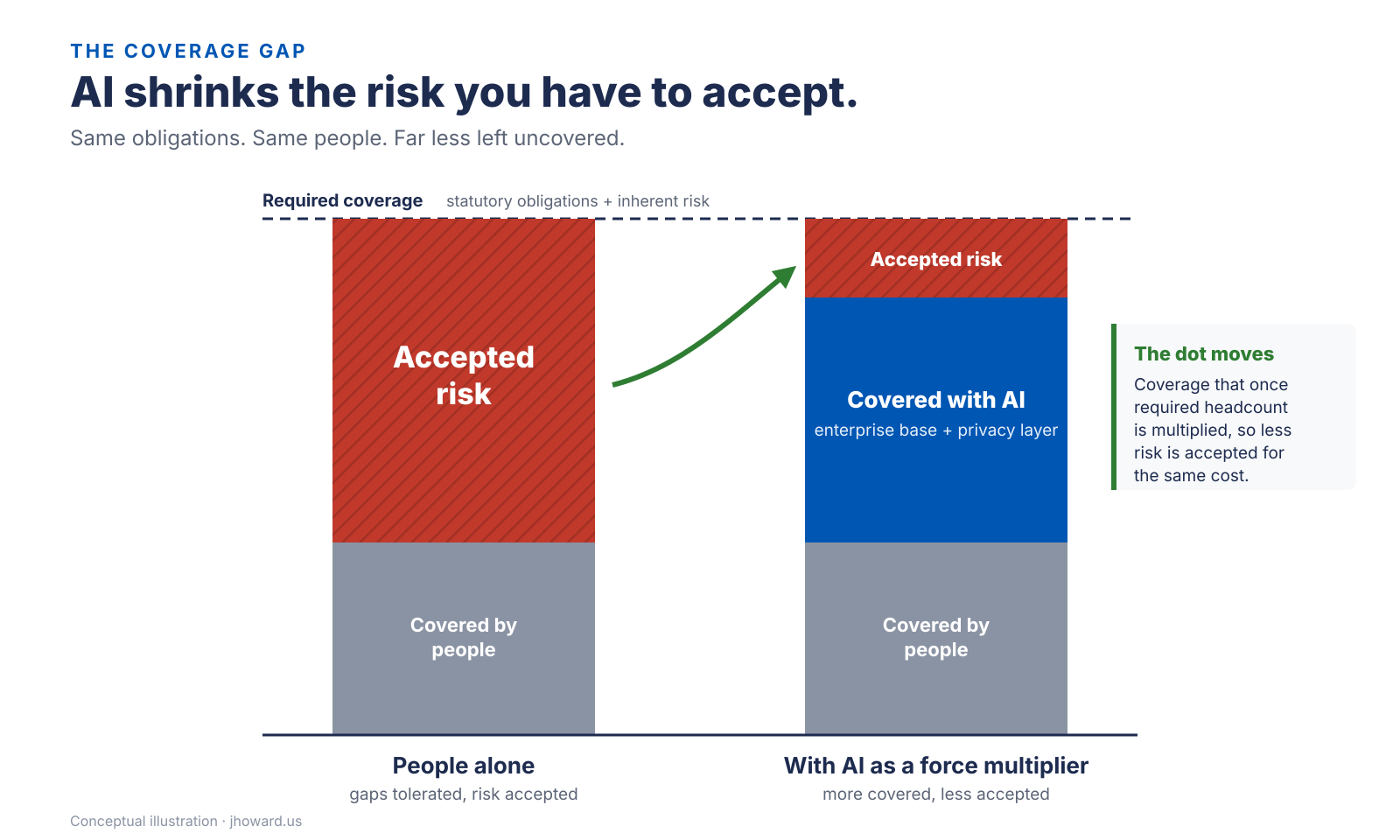
Meeting every statutory obligation and addressing every inherent risk has traditionally required more people than can be cost-justified. Programs close the gap the only way they can: they cover the highest-priority obligations well and tolerate gaps elsewhere. That gap is residual risk that has been accepted, often by default rather than by decision.
Over time, that acceptance drifts. The question quietly shifts from “are we compliant?” to “how likely are we to be caught, or to cause harm?” That is an enforcement calculation, not a compliance one. It is rarely made explicitly, and it rarely survives an audit finding, a regulatory inquiry or an incident.
The economics have held because the only way to add coverage was to add people. AI changes that. Work that once required headcount, such as reading, classifying, searching and drafting, can now be multiplied, so less risk has to be accepted for the same cost.
2. Why Is the Gap Getting Harder to Sustain?
The gap is getting harder to sustain, particularly on the obligations side.
Rights requests are growing in volume, complexity and consequence. Individuals now use generative AI to draft long, legally sophisticated requests in seconds,2 and requests are increasingly organized: some are filed in bulk to gather material for litigation, and some opportunistically, to provoke a failure and claim compensation. Europe’s highest court confirmed in 2026 that a mishandled access request can itself give rise to compensation, even where the underlying processing was lawful.3 Every request, however it was drafted or organized, carries a deadline that runs from the day it arrives.
Incident rules keep tightening. The SEC’s amended Regulation S-P requires a written incident response program and notice to affected individuals within 30 days,4 joining the GDPR’s 72-hour regulator notification and a patchwork of state laws. Meeting those deadlines depends on knowing quickly whose data was affected and which rules apply.
3. What Are the Four Foundations, and Where Do They Sit?
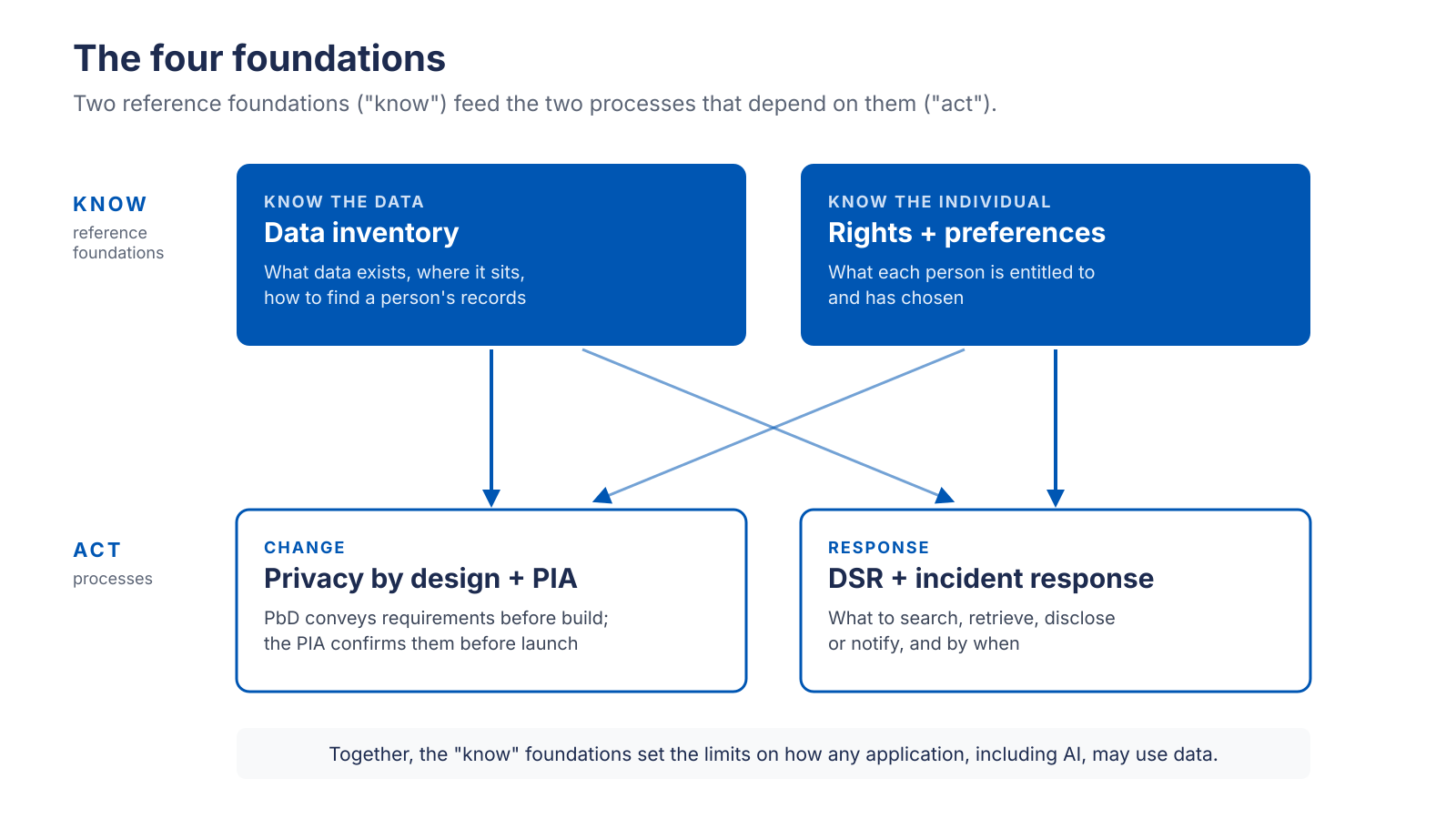
Four foundations carry most of the obligations load, and they are not independent.
Two are reference foundations:
- The data inventory tells the organization what data it holds, where it sits, and how to find a specific person’s records.
- The rights and preferences profile tells it what each individual is entitled to and what they have chosen: consents, opt-outs, objections.
The other two are processes that depend on them:
- Privacy by design (PbD) and privacy impact assessments govern change. PbD conveys privacy requirements before development begins, drawing on both reference foundations. The PIA confirms, after development and before launch, that those requirements were met.
- DSR and incident response query both to define what must be searched, retrieved, disclosed or notified, and by when.
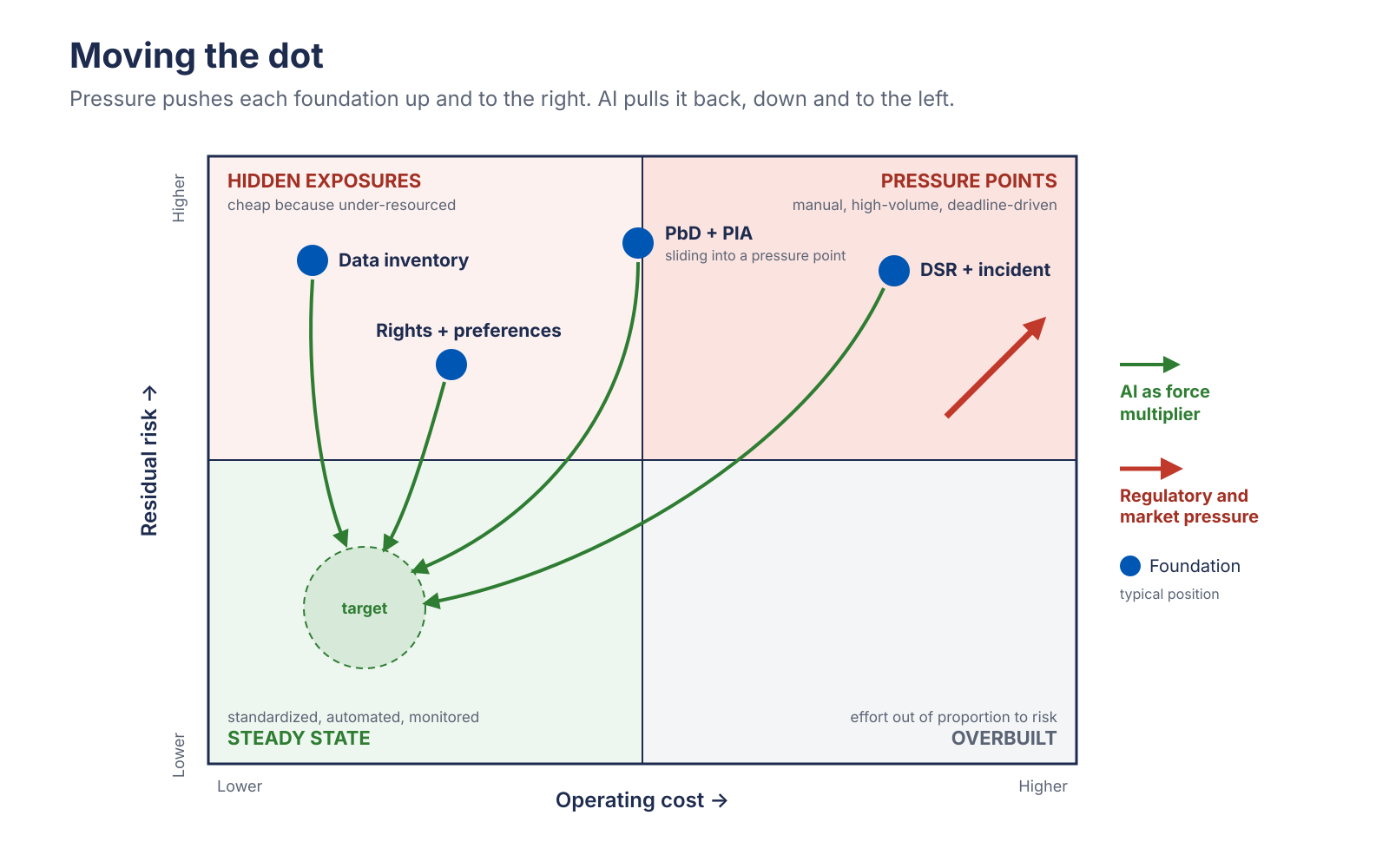
Plot each foundation by its residual risk and operating cost. Residual risk measures where each foundation sits; accepted risk is the part of it the organization is choosing to live with.
| The Risk-Cost Matrix | ||
|---|---|---|
| Lower cost | Higher cost | |
| Higher risk | Hidden exposures: cheap because under-resourced, not because well-run | Pressure points: manual, high-volume, deadline-driven |
| Lower risk | Steady state: standardized, automated, monitored | Overbuilt: effort out of proportion to the risk it manages |
In many organizations, the foundations sit like this:
- Data inventory is often a hidden exposure: manual, rarely current, and too costly to cover the full breadth of the organization’s data. Application inventories often serve as a proxy, but their narrow view doesn’t support a common taxonomy or enterprise-wide classification.
- Rights and preferences are often a hidden exposure, scattered across systems and markets. That’s cheap until an opt-out isn’t honored or a request is scoped incorrectly.
- PbD and PIAs are often a hidden exposure that becomes a pressure point. Without requirements up front, issues surface late, and manual PIAs struggle to keep pace with Agile delivery. They are completed after the fact, forcing costly redesign (or more risk acceptance), or not at all, leaving a blind spot.
- DSR and incident response are the pressure points: high-volume, deadline-driven, and inheriting every weakness in the reference foundations.
The hidden exposures are where risk acceptance lives. The pressure points are where it fails first. Rising pressure pushes every foundation up and to the right. The objective is to move them back, down and to the left.
4. How Does AI Change the Equation?
Most of the cost in a privacy program comes from people reading things: system documentation, call transcripts, emails, request letters, incident reports. AI is good at exactly that work. It can classify data, interpret a sprawling request, flag a likely rights request in a chat transcript, or draft a first-pass assessment, all for a person to confirm.
The enterprise is probably already paying for much of the capability. Security teams have invested in data discovery and incident management. Data teams run catalogs and lineage tools. Contact centers use speech and text analytics. Legal owns eDiscovery. Delivery teams run Agile tooling. Most organizations now license an enterprise AI platform.
But these were built for other purposes, and they rarely meet privacy’s needs on their own. A data catalog knows where data sits, not who it belongs to, what each person has permitted, or how long it may be kept. Incident management is traditionally owned by information security, with privacy running in parallel or added on afterward. The practical model is to leverage the enterprise base and add a privacy layer, which often means targeted investment in privacy management tools that bring privacy context to the platforms the organization already runs.
| AI as a Force Multiplier: Leverage the Base, Add a Privacy Layer | |||
|---|---|---|---|
| Foundation | What AI does | Enterprise base to leverage | Privacy layer to add |
| Data inventory | Scans systems, classifies personal data, maps it to a common taxonomy, keeps it current | Data catalogs and lineage, data security posture management, application inventories | Privacy taxonomy and classification; links to individuals, purposes, legal bases and retention |
| Rights and preferences | Interprets free-text requests and preferences, matches identities; rights determination stays rule-based | Customer platforms, identity services | A rights and preferences engine: jurisdictional rules, consents and opt-outs, propagated to applications |
| PbD and PIAs | Generates requirements at intake; scans code for use of personal data and reconciles it with permitted purposes; embeds a short assessment in delivery tools; triages risk; drafts findings | Enterprise AI platform, Agile and workflow tools, code repositories and CI/CD pipelines, GRC | Privacy requirements library and assessment workflow integrated with delivery, linked to the inventory and rights and preferences |
| DSR and incident response | Detects requests in calls, chats and mailboxes; automates retrieval; proposes redactions; reviews incidents for privacy impact | Contact-center analytics, eDiscovery, security incident management, case management | DSR orchestration; privacy impact triage and notification rules within the incident process |
In each case, AI moves the foundation down and to the left: the enterprise base keeps cost down, and the privacy layer makes the risk reduction real. AI pays off first in the reference foundations, because every downstream process draws on them. Automating response on top of weak foundations simply produces wrong answers faster.
Privacy leaders see the opportunity but are moving cautiously. In a small 2026 benchmark, privacy ranked first of eleven functions on automation ambition and near last on trust in AI.5 Notably, the AI these leaders trust and use most is the AI embedded in enterprise platforms they already run, which is where the practical path begins.
5. How Should AI Itself Be Managed?
Using AI in a privacy program is defensible, and increasingly expected, but it introduces risks of its own: it processes personal data (including employees’), models make mistakes, third-party services raise disclosure and data-location questions, and AI regulation is evolving quickly.
AI is an assistant, not a decision-maker, and it must be managed like any other control:6
- Foundations first. AI amplifies whatever it is built on.
- Human in the loop for disclosures, denials, deletions, notifications and assessment outcomes.
- Purpose limitation, with no drift into performance management or marketing.
- Accountability for every AI tool: a defined role and limited permissions, a named owner, a record of what it did, and the ability to stop it quickly.
- Architecture by design: run AI where the data already sits, and account for data location and emerging AI rules.
6. What Should Executives Do Now?
- Make the risk acceptance explicit. Identify where coverage gaps are being tolerated, and whether that is a compliance decision or an enforcement calculation.
- Plot the foundations on the matrix using real indicators: request volumes, cycle times, missed deadlines, late or skipped assessments, audit findings.
- Inventory what you already own, and identify the privacy layer each needs: the catalog, security, analytics, eDiscovery, delivery and AI platforms the enterprise has funded.
- Strengthen the reference foundations first.
- Accelerate the pressure points with named workflows, starting with DSR and incident response and bringing PbD and PIAs onto the delivery critical path.
- Measure the movement: cost per request, cycle times, inventory coverage, PIAs completed before launch, and the risk no longer being accepted.
Two Questions for Boards and Audit Committees
- Where is our privacy program accepting risk today, and who decided?
- Which enterprise investments could support privacy, and what privacy layer would they need?
Conclusion: Moving the Dot
For years, privacy programs have balanced what the law requires against what they can afford, and closed the difference with risk acceptance. Rising pressure is making that balance harder to hold. AI does not eliminate the trade-off, but it changes its terms.
Built on strong foundations, investments the enterprise has already made and a targeted privacy layer, it lets organizations cover more while accepting less risk, without a matching rise in cost. Organizations that manage it well will respond faster, see their data more clearly, and earn the trust that turns privacy into a competitive advantage.
Notes
- This article focuses on obligations owed to individuals and regulators: rights, consent, change and incident response. Rising complexity affects program design and cost more broadly. New requirements must be translated into processes and applications across the enterprise, and programs also carry the cost of notices, third-party oversight, cross-border transfers, training and governance reporting. The same force-multiplier logic applies to many of these, but they warrant separate treatment. ↩
- Ireland’s Data Protection Commission reported more than 16,000 contacts in 2025, a 45% increase on the prior year, and noted that access requests are increasingly long and AI-generated. Data Protection Commission, Annual Report 2025. ↩
- Court of Justice of the European Union, Brillen Rottler GmbH & Co. KG v TC, Case C-526/24, judgment of 19 March 2026. The Court also held that clearly abusive requests may be refused, but only on evidence, and that refusing a first request should remain exceptional. ↩
- U.S. Securities and Exchange Commission, amendments to Regulation S-P (adopted May 2024). Larger covered entities were required to comply by December 3, 2025, and smaller entities by June 3, 2026. ↩
- Assemble, The State of AI in Data Privacy, Decision Intelligence Benchmark special report (survey of 26 data privacy leaders, February–March 2026). ↩
- AI proposes, people decide, accuracy is measured, and changes follow model governance. Organizations can keep AI close: on-premises, within their own cloud environment, or inside platforms they already use. They can also tailor it to internal data. Retrieval, where the model reads internal data at the moment of use, keeps personal data out of the model itself. Fine-tuning on personal data embeds it in the model, making the model a new repository that must be inventoried, secured and subject to individuals’ rights. As AI use grows, the reference foundations should extend to training data, models and agents. ↩